
The Monthly SUC - Atlas Is Shrugging, Part 1
Universal Basic Income: The Great Destroyer of Worlds

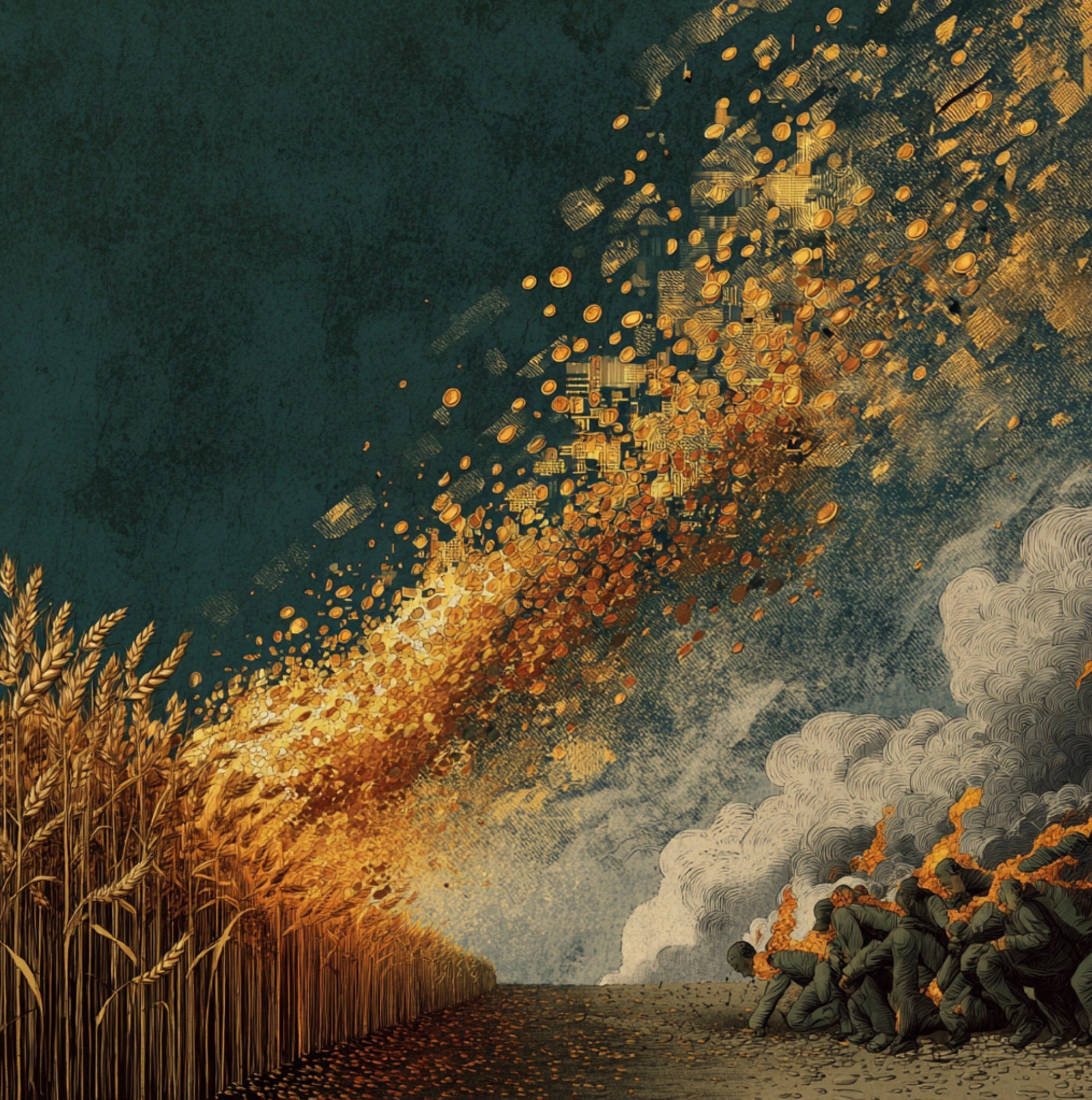
There’s a policy idea floating around right now that sounds, on its face, like the most humane thing a government could do. Give people money. No strings attached. Enough to survive. A floor beneath which no citizen can fall.
Universal Basic Income. UBI. The policy equivalent of a warm blanket and a cup of soup. Who could argue against it?
I can. And I’m going to. Not because I think it’s evil. But because I’ve read enough history to know what happens when you give a population everything it needs to live and nothing it needs to matter. And because I wrote a novel about it — years before the conditions that would make it inevitable started falling into place.
Bread and Circuses: The Original UBI
In 123 BC, a Roman politician named Gaius Gracchus had a problem. The city of Rome was swelling with landless citizens — farmers driven off their land by debt and the rise of massive slave-worked estates. They were poor, angry, and volatile. Gracchus needed their votes. So he gave them grain. Subsidized, then free. A guaranteed food supply for any Roman citizen who showed up.
It worked. Gracchus got his votes. The poor got their bread. The streets stayed calm.
And then the program never ended.
No Roman politician — not a single one in over five centuries — successfully repealed the grain dole. Sulla tried in 81 BC. It was restored within years. Augustus, the first emperor, initially resisted the idea of a permanent dole but ultimately recognized that cutting it would mean riots. He called the grain supply one of the three foundations of Rome.
The dole started with 50,000 recipients. Within a generation, it was 200,000. Eventually, registered citizens received daily bread, pork, olive oil, and salt — all free. The poet Juvenal watched his countrymen abandon civic duty for handouts and coined the phrase that still haunts us: panem et circenses. Bread and circuses.
Here’s what happened, mechanically, to Rome:
Citizens flooded the cities to claim the benefit. Farmers abandoned farming — the very mechanism that made the grain dole possible — because why break your back in a field when bread shows up for free? Rome became a civilization that elevated consumption at the expense of production. The city of a million people couldn’t feed itself. It became entirely dependent on grain imported from North Africa and Egypt, shipped across the Mediterranean on a supply chain that was fragile, expensive, and strategically vulnerable.
In 439 AD, the Vandals seized Carthage and the North African provinces. Rome’s granary was gone. The dole collapsed. The city that had been pacified by free bread for five centuries had no mechanism to feed itself and no population that remembered how. The breakdown of the grain system contributed directly to the political upheaval, social unrest, and eventual collapse of the Western Roman Empire.
The dole didn’t kill Rome. But it did make Rome brittle. It replaced self-reliance with dependency, production with consumption, and civic participation with passive receipt. By the time the external shock arrived, the population had been dimmed — not by a tyrant, but by generosity — into a state of helpless dependence from which it could not recover.
The bread was the weapon. And nobody saw it coming because it tasted so good.
The Great Society: A Hand Up That Became a Hand Down
Fast forward two thousand years. Same species. Same instincts. Same mistake.
In 1964, President Lyndon Johnson declared “an unconditional war on poverty.” The Great Society programs that followed — Food Stamps, Medicaid, expanded housing assistance, Aid to Families with Dependent Children — were designed with genuine compassion. The rationale was simple and humane: poverty causes suffering, government can alleviate suffering, therefore government should act.
The architecture was elegant on paper. Assistance decreases poverty. Decreased poverty decreases the need for further assistance. The program works itself out of a job. A safety net, not a hammock.
But that’s not what happened.
What happened was a feedback loop that the designers didn’t anticipate — or didn’t want to see. The assistance did decrease immediate suffering. But it also decreased the incentive to develop the self-reliance that prevents future suffering. Over time — and this is the critical variable, because the effects take a generation to manifest — the safety net became the floor, and then the floor became the ceiling.
When Johnson came to office in late 1963, more than 90% of all American babies were born to married parents. By 2015, 72% of Black children and over 40% of all American children were born outside of marriage. This is not me picking on any one particular demographic - after all, I don’t make the stats - but rather the system that feeds the environment necessary for these kinds of outcomes. The welfare system, by providing financial incentives to single-parent households while penalizing marriage (married couples often lost benefits), had inadvertently rewired the family structure of an entire population over two generations.
The welfare checks showed up month after month, regardless of how the recipients spent their days. Children grew up in households where government support was the norm, and they came to regard that arrangement as natural. In fact, since the system showed a financial favoritism toward single parents, a perverse incentive to have more children out of wedlock became the standard. The safety net, designed to be temporary, became permanent. Three generations deep. Sometimes four.
The numbers tell the story: after spending approximately $22 trillion on means-tested welfare programs since the War on Poverty began (adjusted for inflation), the poverty rate in America has barely budged. It was approximately 19% in 1964. Today it hovers around 11–12% — a reduction, yes, but one that occurred primarily in the first decade and has flatlined since, despite trillions more in spending.
In 1996, a Republican Congress passed welfare reform legislation that required recipients to work at least 20 hours per week in exchange for benefits. The results were immediate: caseloads were cut in half within five years. Employment among single mothers surged. Child poverty dropped significantly.
The lesson was clear — painfully, uncomfortably clear: when you require something from people, they rise to it. When you require nothing, they don’t. Not because they’re lazy. Not because they’re bad. Because they’re human. And humans, like all organisms, adapt to the incentive structure they’re placed in. Remove the need to work, and the will to work follows. Not instantly. Not visibly. But inevitably, over the slow grind of years and generations.
The Great Society didn’t fail because the people running it were malicious. It failed because it violated a fundamental law of human nature: purpose is not optional. Strip it away — even with the best of intentions — and the organism atrophies.
The Coming Crisis: AI Employment Armageddon
Now here’s where I need you to pay very close attention. Because what I’m about to describe hasn’t happened yet. But the pieces are on the board, and if you know how to read a chessboard, the next several moves are visible.
We are approaching a moment — maybe five years out, maybe three, maybe it’s already begun and we haven’t named it yet (yes, we’re looking at you Strait of Hormuz) — where the following conditions converge simultaneously:
An energy crisis. Global energy markets are structurally unstable. Whether it’s geopolitical disruption, aging infrastructure, the transition costs of green energy, or some combination of all three, there will be a period where energy prices spike dramatically. Energy is the input cost beneath every other cost. When energy goes up, everything goes up. Inflation becomes sticky. Resistant. The kind that doesn’t respond to interest rate adjustments because it’s rooted in the physical cost of doing anything at all.
A recession. The global economy, already fragile from post-pandemic distortions, will contract. Consumer spending drops. Business investment freezes. The normal cyclical downturn that happens every decade or so — except this time, it coincides with something that has never happened before.
Widespread AI adoption during an economic crisis. Here’s the new variable. In every previous recession, companies cut costs by laying off workers. Then, when the economy recovered, they hired them back. That was the cycle. Recession, layoff, recovery, rehire.
This time, the companies that lay off workers will discover — many of them are already discovering — that they can maintain the same or greater productivity using LLMs and AI tools at a fraction of the labor cost. The accountant gets replaced by an AI that does the same work in seconds. The copywriter. The paralegal. The junior analyst. The customer service team. The mid-level manager whose primary function was synthesizing information — a task that AI does better, faster, and without a benefits package.
And when the recovery comes, the jobs don’t come back.
Not because the economy hasn’t recovered. But because the companies have adapted. They’ve restructured around AI. The humans who were laid off during the crisis aren’t needed anymore — not because they’re unskilled, but because the definition of the skill changed while they were looking for work.
This isn’t speculative. This is the trajectory we’re on right now. Every major consulting firm, every tech company, every forward-looking enterprise is quietly running the numbers on how many human employees they can replace with AI systems. They’re not announcing it. They’re modeling it. Waiting for the economic cover — a recession, a downturn, a “restructuring” — to execute the plan without the PR blowback.
When it hits, it will hit fast. Not every industry at once. But enough industries, in a short enough window, that the unemployment spike will be unlike anything we’ve seen since the Great Depression. Except this time, the jobs aren’t coming back when the economy improves. They’ve been structurally eliminated.
The Government Response: Exactly Wrong
And here’s what the government will do. Because I have eyes to see, and the playbook has been the same since the GFC.
Instead of austerity — instead of cutting spending, streamlining government, and allowing the economy to restructure around the new reality — the government will do the opposite. It will panic. It will spend.
To raise revenue, it will raise tax rates across the board. Corporate tax rates will go up, which will further incentivize companies to replace human workers with AI (since AI doesn’t trigger payroll taxes, benefits costs, or HR compliance). Individual rates will climb. The productive class — the people still working, still generating value — will be squeezed to fund the growing class of people who aren’t.
And to address the millions of newly unemployed citizens who can’t find work because the work no longer exists for humans, the government will do the only thing it knows how to do.
It will create a Universal Basic Income.
It will be sold as temporary. Emergency. Compassionate. Just like Rome’s grain dole. Just like the Great Society. Just like every entitlement program in the history of civilization that was designed to be a safety net and became a permanent fixture that no politician dared to touch.
And it will have the same effect it has always had.
It will keep people alive. And it will slowly, imperceptibly, kill their purpose.
The Monthly SUC
I wrote about this years ago. In my novel Complex, the government’s version of UBI is called the Standard Universal Credit — the SUC. Val, the protagonist, calls it “the dreaded monthly SUC” with her fingers wiggling above her head like she’s invoking a ghost story.
The SUC keeps Legacy citizens — the people living outside the corporate Complexes — alive. Barely. They can print food. They can pay subsidized rent. They can exist. But they can’t thrive. There aren’t enough jobs. There aren’t enough reasons to get out of bed. The monthly deposit shows up whether you do anything with your day or not.
Val sees through it instantly. When Trevor tries to explain the system, she cuts to the bone: “We’re getting paid not to work.” He sputters. She holds up her hands. “See these beautiful work-makers?” The human capacity to do — to create, to build, to contribute something to the world — reduced to an irrelevance by a monthly deposit.
But the SUC isn’t just a failed social program in the world of Complex. It’s a tool. There’s a bill — DS-75, code-named EXODUS — that restructures the SUC to force citizens to relocate into controlled territories if they want to keep receiving their credits. The UBI becomes a leash. You can have your money, but only if you move where we tell you. Only if you live where we can see you. Only if you condense yourself into something manageable.
Moon, one of the architects, explains the logic with chilling clarity: food, shelter, and health aren’t enough. The thing that makes the Complexes attractive isn’t the material provision — it’s purpose. The Complexes give people work. Work gives people worth. Legacy gives people a check and calls it freedom, but freedom without purpose is just a nicer word for abandonment.
And Greitens — the old-guard politician who sees the SUC as generosity — delivers the line that should be tattooed on the forehead of every policymaker who’s ever championed UBI without thinking through the second-order effects: “Fuckers don’t even have to work if they don’t want to, just live off their monthly SUC. I’d call that a better than fair deal.”
He thinks he’s being kind. He has no idea he’s describing a cage.
The Trap
Here’s what Rome, the Great Society, and the world of Complex all have in common. Here’s the pattern that repeats across two thousand years of human civilization:
A government, faced with a population in crisis, provides material support. The support alleviates immediate suffering. The population adapts to the support. The adaptation erodes the self-reliance, the purpose, and the productive capacity that would have allowed the population to recover on its own. The government, unable to withdraw the support without risking unrest, expands it. The dependency deepens. The productive base shrinks. The tax burden on the remaining productive class increases. The productive class shrinks further — or, in our coming scenario, gets replaced by machines. And the cycle accelerates until the system is so brittle, so hollowed out, so dependent on a supply chain of someone else’s productivity, that a single external shock — a famine, a war, an energy crisis, a supply chain disruption — breaks it.
The UBI isn’t a solution. It’s the last move before the board gets swept.
And here’s the cruelest irony of all: the people who will be hurt most by it are the people it’s designed to help. The people who lose their jobs to AI, who can’t find new work because the new work doesn’t exist for humans, who accept the monthly check because they have no alternative — those people will not be saved by UBI. They will be pacified by it. They will be maintained in a state of biological survival and spiritual starvation, their strange loops dimming month by month, their sense of purpose evaporating like water on hot pavement.
And the system that emerges — a small class of AI-augmented elites generating value, a vast class of UBI-dependent citizens consuming it, and a government mediating between the two with an ever-expanding bureaucracy funded by ever-increasing debt — that system has a name.
In my novel, they call it a Complex.
Purpose Is the Point
I’m not arguing against helping people. I’m arguing against helping people in a way that destroys them.
The 1996 welfare reform proved something that the Great Society architects didn’t want to hear: people rise when you ask something of them. Caseloads halved. Employment surged. Child poverty dropped. Not because the government stopped caring. Because it started expecting.
If AI is going to displace millions of workers — and it will — the answer isn’t to pay them to sit at home and watch their purpose evaporate. The answer is to build systems that redirect human energy toward things AI can’t do. Community. Caregiving. Craftsmanship. Trade work. Mentorship. Art. The irreducibly human work that no algorithm can replicate because it requires the one thing a machine doesn’t have: a strange loop that cares.
That’s harder than writing a check. It’s messier. It’s slower. It requires imagination and political courage and a willingness to treat people as capable rather than helpless.
But the alternative — a monthly deposit, a population without purpose, a civilization that consumes without producing and exists without mattering — is not a safety net.
It’s a coffin with a direct deposit.